
By Nayara Güércio
.
What happens when truth begins to feel negotiable?
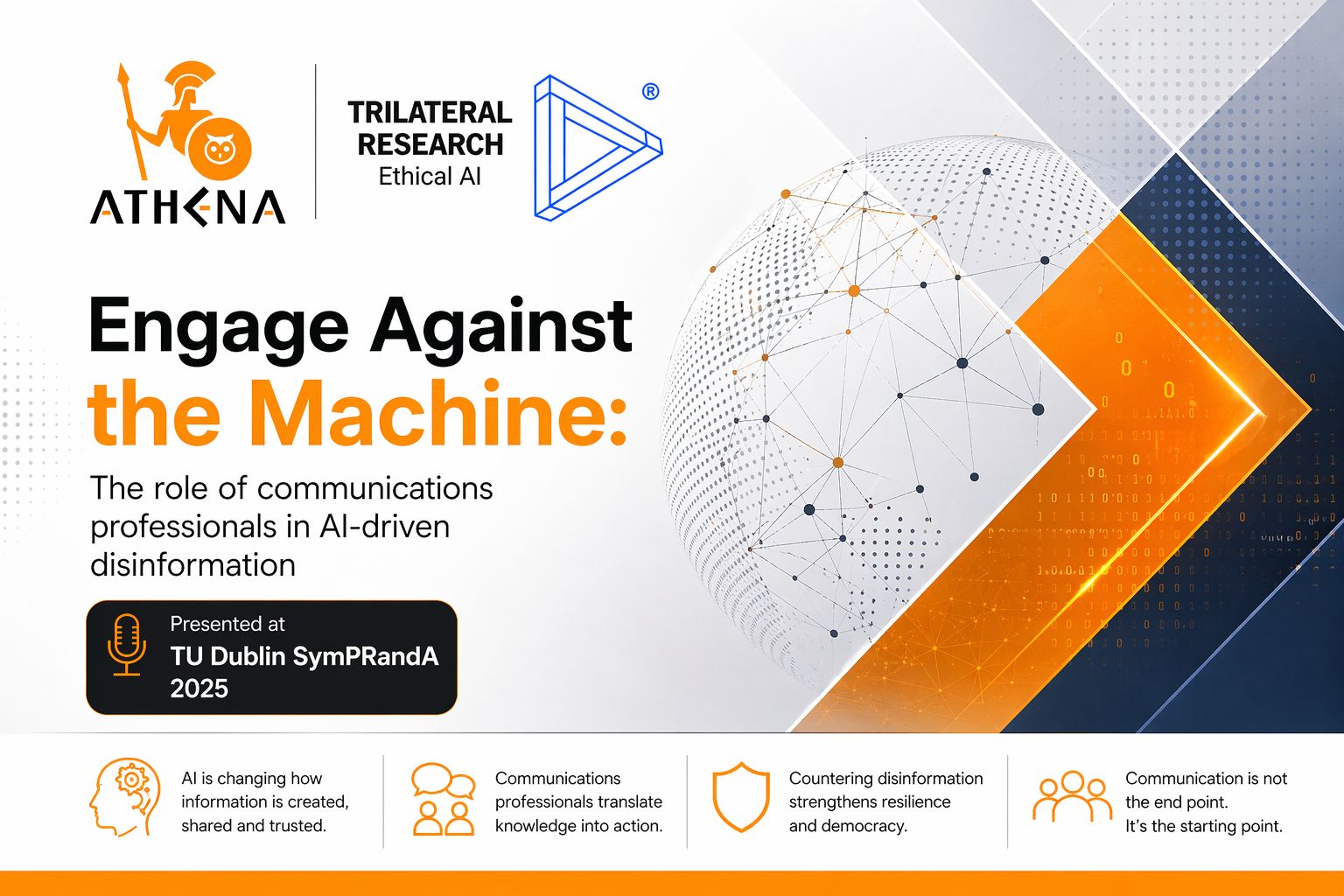
That was the question at the heart of my recent presentation, “Engage Against the Machine: The role of communications professionals in AI-driven disinformation” at TU Dublin‘s 2026 SymPRandA – Credibility, Content and AI: Rethinking PR Practices.
From the beginning, the session felt less like a warning about technology or AI and more like a conversation about people: what we believe, who we trust, how we recognise truth, and how fragile certainty can become in a crowded information environment. Rather than starting from fear, the audience was invited to pause and ask the question: what happens to public trust when convincing images, videos, voices, and stories can be created and shared at extraordinary speed?
The presentation began with a provocation. Why has artificial intelligence become such a major societal issue now? After all, manipulation and disinformation are hardly new phenomena. People have always tried to shape opinion, bend facts, and use media to influence public life. What has changed is the scale and rhythm of the problem. Misleading content can now move quickly, look convincing, and reach audiences before verification has a chance to catch up.
One of the ideas that resonated most was the “liar’s dividend”, the unsettling effect that happens when people know that media can be manipulated. From that point om, the problem is no longer limited to fake content. Even authentic evidence becomes vulnerable. A legitimate video can be denied, a real image can be questioned, and a documented fact can be pushed into doubt. This is what makes disinformation so damaging: it does not just create falsehoods, it weakens the conditions that allow truth to be recognised.
This is where the discussion moved to FIMI: Foreign Information Manipulation and Interference. In simple terms, FIMI is organised manipulation. It is the deliberate use of information to influence public debate and disrupt democratic processes. Its danger is not always immediate or obvious. It often works slowly, by making people less trusting, more divided, and more doubtful of the institutions around them. The presentation showed this as an ecosystem, where hostile actors, online platforms, misleading content, audiences, and real-world consequences are all part of the same chain.
This is where ATHENA came in. Having our project as a case study in and of itself grounded the discussion in real work. ATHENA shows what happens when research impact and communications are treated as part of the response: complex work on disinformation and FIMI becomes clear and available to the audiences who need it.
The audience was then taken through examples of disinformation in practice, including narratives around climate change and election-related manipulation. These examples helped show that FIMI is seldom about one false post or one misleading image. It is coordinated and often relies on repetition, timing, emotional appeal, amplification, and carefully planted doubt. It works because it does not always need people to believe one specific lie. Sometimes, it only needs to make them feel that nothing can be trusted.
This is where communications becomes part of the solution.
The presentation argued that communication is not a final step that happens after research has been completed. It is part of the response itself. In projects such as ATHENA, communication helps turn findings into policy briefs, webinars, newsletters, social media strategies, training materials, and public-facing resources. These outputs do more than raise awareness. They help educators, policymakers, journalists, researchers, and the wider public recognise manipulation and respond to it.
PR and communications professionals are not peripheral to democratic resilience. They are part of what allows democratic life to keep functioning when trust is under pressure. In unstable information environments, the work of explaining clearly, providing context, verifying claims, and making knowledge accessible cannot be treated as secondary. The aim of a communications professional is not to compete for attention. It is to help people navigate uncertainty with (more) confidence.
Research impact officers, journalists, PR professionals, and media workers sit between complex information systems and the public. And this position comes with responsibility.
Finally, the presentation turned to the future of communications practice. Communications professionals may need to assess how messages could be misread or distorted before they are released, monitor narratives as they emerge, make verification more visible, and work more closely with other media professionals, as well as policy, research, and technical teams.
In the end, Engage Against the Machine was not a warning to step back from technology. It was an invitation to step forward as communicators, with more care, more clarity, and a stronger sense of responsibility for the public conversations we help shape.