
By Dr David Wright
.
The ATHENA project has been using horizon scanning and other foresight methods to understand how new and emerging technologies will impact foreign information manipulation and interference in the next three to five years.
In this blog, we focus on the different methods used in foresight and, especially, how artificial intelligence is impacting those methods.
Let’s start with some context.
The EC has defined foresight as “a systematic approach to look beyond current expectations and explore plausible future developments”. People use foresight to consider plausible futures; to help in decision-making, and to engage stakeholders.
Two proverbs capture the essence of the value of foresight: “Forewarned is forearmed’. In other words, if you know what’s likely to happen, you can take steps to mitigate potential risks. “Vigilance is the price of freedom”. In other words, we have to pay attention to what might happen if we want to be free. We cannot be free if we are trapped by the future.
Lots of people use foresight, for example:
- Corporations – e.g., Shell was one of the first big corporations to employ scenario planning.
- International Panel on Climate Change (IPCC)
- The European Commission – e.g., in the early 2000s, the EC created four ambient intelligence scenarios to show the magical benefits of a future embedded with IoT devices.
- Horizon projects – e.g., SWAMI, SHERPA, ATHENA
- Military in war-gaming
- Activists
- Consultants
We identify six main foresight methods:
- Horizon scanning
- Scenario construction
- Delphis
- Megatrend analysis
- Backcasting
- Roadmapping
In the case of horizon scanning, experts scan a wide range of materials, depending on the topics – e.g., journal articles, public opinion surveys, blogs, policy documents, news media, “grey literature”, advertising. The horizon scanner enlists several (or more) experts to scan the horizon for “weak signals”, i.e., signs of key developments that could have a big impact on the future. As with other foresight methods, timeliness is an issue in at least two ways in horizon scanning. One is how long experts spend scanning the horizon and making sense of the weak signals. A second is how long it takes decision-makers to act on the horizon scan. There’s always a risk that events can overtake the foresight method.
The ATHENA project has used horizon scanning and conducted a Delphi.
In the case of Delphis, the Delphi manager invites 20 or more experts to respond to a set of questions. They remain anonymous to each other. The manager drafts a synthesis of the responses and invites the experts to comment on the synthesis and to respond to a second round of questions based on the synthesis. Based on their responses, the manager again drafts a synthesis and invites the experts to respond a third and final round of questions. The manager then shares the results of the three rounds with stakeholders. Experts can say whether they now wish to be identified
Delphis have pros and cons, among which are these:
- Experts share views anonymously, no attribution, free to express whatever views they wish without being influenced by other respondents.
- Need to keep experts on board throughout the process. If there are long stretches between rounds, some experts may drop out of the process.
- Usually a minimum of 20 experts is needed for credibility.
- Usually three rounds.
- The Delphi should aim for an exchange of informed views, not consensus necessarily or accommodating outliers.
Megatrends analysis identifies long-term structural drivers of change (e.g., climate change, ageing, digitalisation).[1] The analysishelps frame scenarios and prioritise uncertainties. It provides a shared evidence base for stakeholders. A downside is that the megatrend analysis is not very granular. There is a risk that it can be too general or deterministic if not contextualized. The credibility of participating experts is an issue.
Backcasting poses a set of questions to participants:
• Where do you want to be in three to five years?
• What conditions do you want?
• What steps are needed to get from there back to here
Similarly, in roadmapping, participants have to consider questions like these:
• What do we need to do to achieve our objectives?
• Can we achieve consensus from stakeholders
The roadmapping process can be very complex and time-consuming. There is also an issue regarding the credibility of inputs.
Now, let’s take a closer look at scenario construction. There are several types of scenarios:
- Four orthogonal
- Worst case, status quo, best case
- Ethical dilemma scenarios
- Policy scenarios
- What-if scenarios
- Scenario databases for autonomous driving
- OpenSCENARIO: a “script” for traffic situations
- Synthetic Population Generation to test social and public-health interventions & multi-agent models
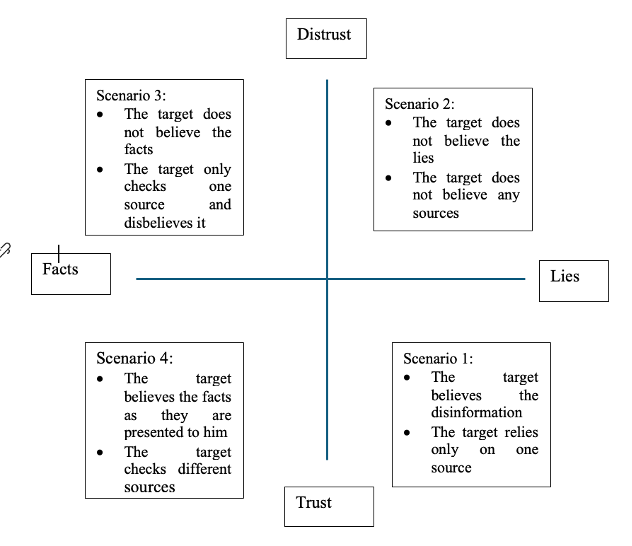
Here is what orthogonal scenarios might look like.
[1] For an example of a megatrends analysis, see: European Commission, 2025 Strategic Foresight Report: Resilience 2.0: Empowering the EU to thrive amid turbulence and uncertainty, COM(2025) 484 final, 9 Sept 2025. https://eur-lex.europa.eu/legal-content/EN/TXT/PDF/?uri=CELEX:52025DC0484
The scenario construction process typically involves these steps:
- The scenario manager invites a group of about 10 experts with different competencies and backgrounds to participate in the scenario construction process.
- The experts brainstorm on the drivers behind the scenarios
- The scenario manager drafts a scenario based on the brainstorming and then runs it by the group for comments.
- He/she revises the scenario based on comments.
- He/she tests the scenario on wider groups of stakeholders. Based on their comment, he/she revises the scenario again and presents it to the decision-makers.
With the advent of AI, scenario construction need not be so labour intensive. AI enables:
- Large scale scenario construction (hundreds of automatically generated scenarios)
- Near real-time scenario iteration
- Continuous updating
- Systematic exploration of complex iterations.
- Agent-based modelling to test how decisions perform across different futures, to determine which options are most robust.
Large-scale scenario generation is used in domains such as energy, mobility, defence, healthcare, where there is a need for not just three or four scenarios, but many. Nevertheless, there should be a human in the loop. Human judgement remains essential for:
- problem framing
- selection of relevant drivers
- interpretation of outputs
- plausibility and strategic relevance.
The scenario manager needs to consider risks that could arise in the scenario construction process:
- Plausibility of the scenarios
- Legitimacy of the process
- Inadequate stakeholder engagement
- Special interests might sway the results.
- Timing = events overtake plausible futures
- Getting the attention of policymakers.
- Human in the loop, yes or no
- AI agents, trained to succeed, escalate quickly, push nuclear war to win[2]
The Turing Institute has commented that “currently no AI system that can reliably predict geopolitical flashpoints or forecast their implications”.
When to use what
Horizon scanning → early signals / uncertainty
Scenarios → exploring alternative futures
Delphi → expert convergence/divergence
Backcasting → policy planning
Roadmapping → implementation
Among the signs of a successful foresight process are these:
- Stakeholders have been engaged
- Senior management or the decision-makers support the process.
- Foresight results are taken up by policymakers, senior management, stakeholders.
- The foresight process yields better policy robustness under conditions of uncertainty.
- The process has enabled early identification of risks & opportunities.
- It facilitates cross-sector alignment; stakeholders are on the same page.
- Identifying plausible future reduced “policy regret” – i.e., that “all” plausible futures were considered.
[2] Ankit Panda and Andrew Reddie, ‘I’m Sorry, Dave. I’m Afraid I Can’t De-Escalate: On (AI) Wargaming and Nuclear War’, War on the Rocks, 21 Apr 2026. https://warontherocks.com/im-sorry-dave-im-afraid-i-cant-de-escalate-on-ai-wargaming-and-nuclear-war/
.
Posted by: Nayara Güércio (Trilateral Research)